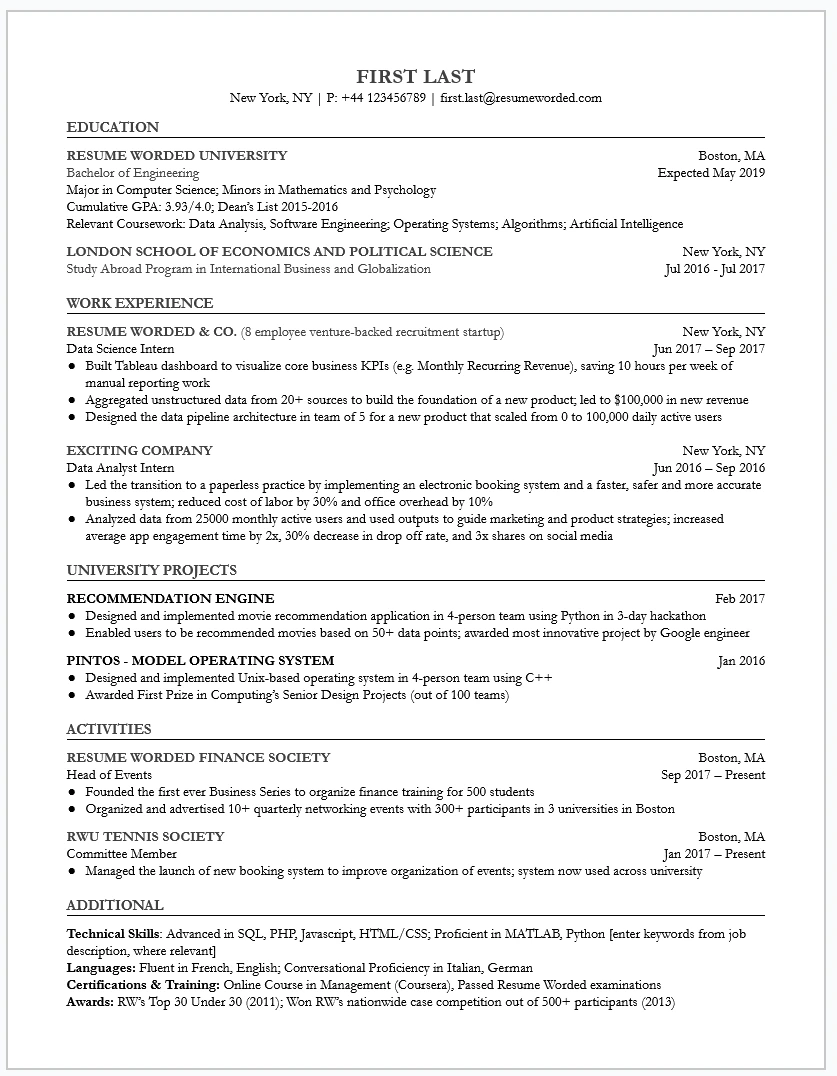
Free Executive Resume Templates - For C-Suite & Senior Leadership
Executive-level templates that showcase strategic impact, board experience, and leadership achievements. For CEOs, VPs, and directors. 2-page format standard.
What makes an executive resume different from other professional resumes?
Executive resumes focus on strategic impact rather than tactical execution. Key differences include a prominent executive summary (3-5 lines highlighting leadership philosophy), P&L responsibility and scope (revenue, budget, team size), board and C-suite interactions, transformation and change management, enterprise-wide strategic initiatives, and industry thought leadership.
Executive resumes emphasize outcomes like "Led $500M digital transformation driving 40% efficiency gains" rather than "Managed IT department." They showcase business acumen, understanding of market dynamics, competitive positioning, stakeholder management, not just functional expertise.
73% of executive recruiters say the executive summary is the most critical section, as it immediately establishes strategic thinking and leadership value. Executive resumes should quantify scope: number of direct/indirect reports, budget responsibility, revenue impact, markets or regions covered, and strategic initiatives led.
Last updated: January 2026.
Should executive resumes be 2 pages?
Yes, 2 pages is the standard for executive resumes, and 89% of executive recruiters prefer this length. Unlike mid-level roles where 1 page is ideal, executive resumes require space to showcase breadth of leadership experience, strategic initiatives across multiple roles, board and advisory work, industry recognition and thought leadership, and enterprise-wide impact.
One page looks insufficient for senior roles and may signal lack of substantial achievements. Three or more pages risks losing attention, executive recruiters spend an average of 15-20 seconds on initial review.
How to use 2 pages effectively:
• Page 1: Executive summary, most recent 1-2 roles (with detailed accomplishments)
• Page 2: Earlier career roles (condensed), education, board positions, and professional affiliations
67% of C-suite professionals use 2-page resumes, 28% use 1.5 pages, and only 5% exceed 2 pages. For CEO and board positions, 2 pages is almost universal (94%).
Last updated: January 2026.
How should I display board experience on an executive resume?
Board experience should be prominently featured in a dedicated section, typically after your professional experience or at the bottom of page 1. Include the organization name and type (public, private, nonprofit), your role (Board Member, Board Chair, Advisory Board), dates of service, and 2-3 bullet points highlighting strategic contributions or governance work.
Format example:
"Board Member, TechCorp Inc. (NYSE: TECH) | 2021-Present
• Serve on Audit and Compensation committees for $2B SaaS company
• Advised on $300M acquisition strategy and post-merger integration
• Championed cybersecurity governance framework adopted company-wide"
Board work demonstrates strategic thinking, governance expertise, fiduciary responsibility, ability to operate at highest organizational level, and industry credibility and network.
61% of C-suite executives serve on at least one board, and 78% of executive recruiters view board experience as a significant differentiator for CEO and senior leadership roles. For advisory boards, clearly distinguish from formal boards, advisory positions carry less weight but still show thought leadership.
Last updated: January 2026.
What should I include in an executive summary?
An executive summary is a 3-6 line statement at the top of your resume (immediately after your name and contact info) that positions your leadership brand. Include your leadership level and scope (CEO, VP, 20+ years), areas of expertise (2-4 key domains like digital transformation, P&L leadership), signature achievements (1-2 quantified career highlights), and unique value proposition (what differentiates you).
Example: "C-Suite executive with 20+ years driving growth for Fortune 500 technology companies. Led three successful digital transformations generating $800M+ in value. Expertise in SaaS business models, international expansion, and M&A integration. Known for building high-performance teams and translating technical innovation into business results."
Avoid generic statements like "results-driven leader" or "proven track record." Be specific about scope, outcomes, and differentiation. The executive summary should make a recruiter think "this person operates at the level we need."
85% of executive recruiters say a strong executive summary significantly increases their interest in a candidate. Without one, your resume looks like every other professional resume rather than an executive-level document.
Last updated: January 2026.
Do ATS systems work differently for executive-level positions?
Executive roles face different ATS dynamics than mid-level positions. While 89% of Fortune 500 companies use ATS for all roles, executive positions often bypass initial ATS screening through executive recruiters (58% of C-suite hires come through retained search firms), internal referrals or board connections (27%), and direct sourcing by talent acquisition executives (15%).
However, your resume still enters ATS systems and must be ATS-friendly for tracking and evaluation. Executive ATS considerations include simpler formatting (critical, no complex layouts), strategic keywords (industry terms, leadership competencies, technical domains), quantified scope (ATS may scan for revenue, budget, team size metrics), and standard section headers (Executive Summary, Professional Experience, Board Service, Education).
Executive search firms use ATS differently: They manually review resumes but use ATS to track candidates and search historical submissions. Keywords help them find you later when similar roles open.
72% of executive recruiters say they'll review an ATS-friendly 2-page resume more carefully than a highly designed "creative" executive resume. At senior levels, substance over style matters most, but formatting must still be clean and scannable.
Last updated: January 2026.
How do I quantify leadership impact on an executive resume?
Executive resumes must translate leadership into measurable business outcomes. Quantify in these dimensions: revenue impact (grew division from $100M to $400M in 5 years), cost optimization (reduced operating costs 22% while maintaining service levels), team scale (led 1,200+ employees across 15 countries), strategic initiatives (delivered $50M in value through digital transformation), and market performance (increased market share from 12% to 19%).
Framework for executive bullets:
[Action Verb] + [What You Led] + [Quantified Business Outcome] + [Context/Scope]
Example: "Architected and led enterprise-wide supply chain transformation across 8 countries, reducing costs $34M annually (18% improvement) while improving delivery times 25%."
Common executive metrics:
• P&L size and growth
• EBITDA or profitability improvement
• Market share gains
• Valuation increase (for CEOs)
• M&A deal value and integration results
• Team size and organizational design
• Geographic expansion
• Customer/client growth and retention
94% of executive search consultants say quantified achievements are the #1 factor in evaluating executive candidates. Vague statements like "provided strategic leadership" provide no signal of actual impact. Be specific, use numbers, and show business outcomes.
Last updated: January 2026.
Test Your Executive Resume
Check if your resume passes executive search ATS systems. Upload and get your score in 15 seconds.