Free College Student Resume Templates - No Experience Needed
Purpose-built for students, recent graduates, and internship seekers. Highlight your education, projects, and skills—even with zero work experience. ATS-friendly for campus recruiting.
What should I put on my resume as a student with no experience?
Focus on education, skills, and activities that demonstrate competence even without formal work history.
Include in this order:
• Contact information (professional email)
• Education section (degree, major, GPA if 3.5+, expected graduation, relevant coursework)
• Skills section (technical skills, languages, software proficiency)
• Projects section (class projects, personal projects, hackathons)
• Campus involvement (clubs, organizations, leadership roles)
• Volunteer work or community service
• Part-time jobs (even if unrelated to career goals)
• Awards and honors (scholarships, dean's list, competitions)
83% of employers say they value transferable skills from non-work activities for entry-level candidates. A food service job shows customer service, reliability, and time management. A club leadership role shows initiative and teamwork.
Quantify whenever possible: "Led team of 8 members" or "Raised $3,200 for charity event" or "Completed 40-hour coding project".
Last updated: January 2026.
Should students use a one-page or two-page resume?
Students and recent graduates should always use a one-page resume unless you have 10+ years of experience or are applying for academic/research positions.
91% of recruiters prefer one-page resumes from students and entry-level candidates. Hiring managers spend 6-7 seconds scanning student resumes, a second page won't get read.
One-page rule applies to:
• Current college students
• Recent graduates (0-5 years out)
• High school students
• Internship applications
• Entry-level job applications
Two-page acceptable for:
• PhD students with extensive research
• Students with 5+ published papers
• Candidates with 10+ years work experience
• Academic CV submissions
If struggling to fit everything on one page, cut: objective statements (outdated), irrelevant coursework, high school activities (if you're in college), excessive detail about old part-time jobs, and long descriptions, use bullets.
Last updated: January 2026.
Should I include my GPA on my resume?
Include your GPA if it's 3.5 or higher. Exclude it if it's below 3.5. This is the standard cutoff used by 78% of employers for campus recruiting.
GPA guidelines:
• 3.7-4.0: Definitely include, prominently display
• 3.5-3.69: Include, shows solid academic performance
• 3.0-3.49: Optional, consider if it's common in your major
• Below 3.0: Don't include, focus on other strengths
Alternatives if overall GPA is low:
• Major GPA (if higher than overall: "Major GPA: 3.6")
• Junior/Senior GPA (if you improved over time)
• Dean's List or Honor Roll mentions
• Specific relevant coursework with grades
Note: Some competitive industries like consulting, investment banking, and law explicitly require 3.5+ GPAs for consideration. If you're below the cutoff, your application may be automatically filtered out, focus on skills and experience to compensate.
72% of employers say they're willing to overlook lower GPAs if candidates have strong relevant experience, projects, or skills.
Last updated: January 2026.
How should students format their resume for ATS systems?
Student resumes face the same ATS challenges as professional resumes, but campus recruiting portals often have additional quirks.
ATS optimization for students:
• Use standard section headers: "Education" not "Academic Background", "Experience" not "Work History", "Skills" not "Competencies"
• List your degree properly: "Bachelor of Science in Computer Science" not "BS CS"
• Include relevant keywords from job posting (programming languages, tools, methodologies)
• Use simple formatting (no tables, text boxes, headers/footers)
• Save as .docx format (not PDF for ATS submissions)
• Spell out acronyms on first use: "American Marketing Association (AMA)"
Common student ATS mistakes:
• Using creative section names
• Listing coursework without keywords
• Abbreviating everything (major, clubs, skills)
• Using graphics or columns
• Not including keywords from job description
68% of internship applications go through ATS screening. Even campus career center portals like Handshake use ATS parsing.
Test your resume: Our ATS checker has scanned 85,000+ student resumes and identifies the exact issues causing rejections.
Last updated: January 2026.
What's the best resume format for college students?
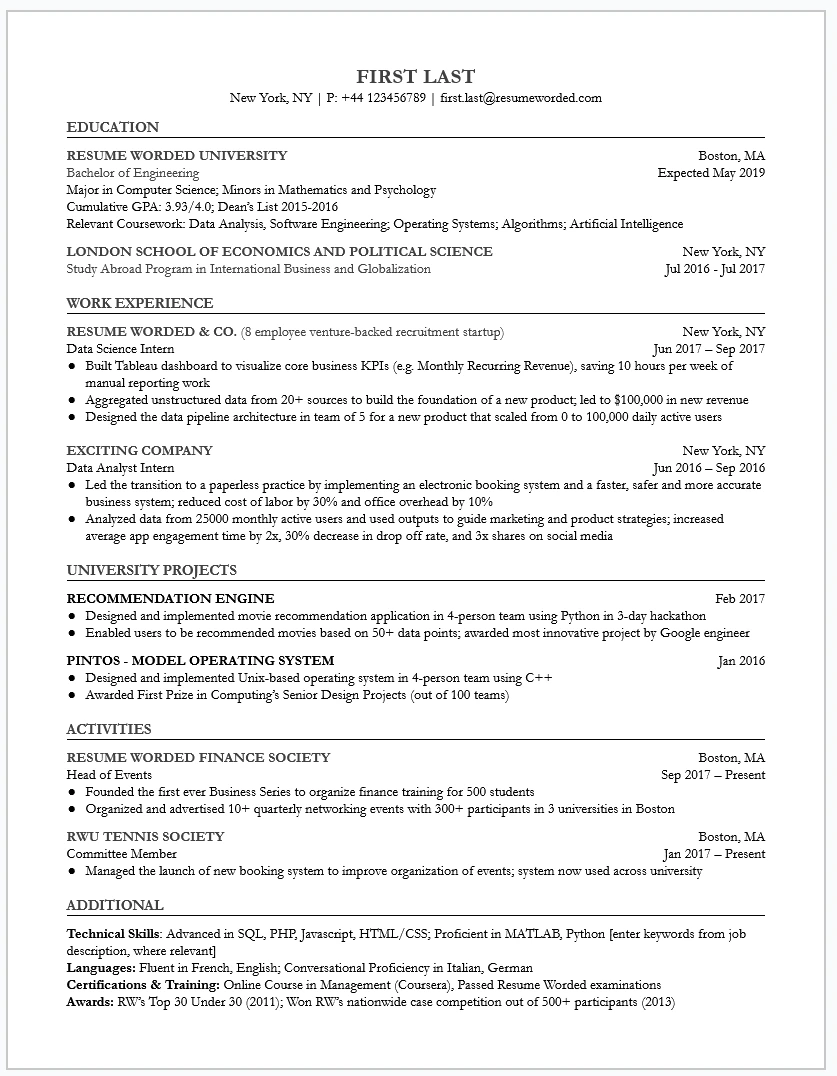
Use the reverse-chronological format with education listed first (instead of experience). This is the best format for 89% of student applications.
Reverse-chronological format for students:
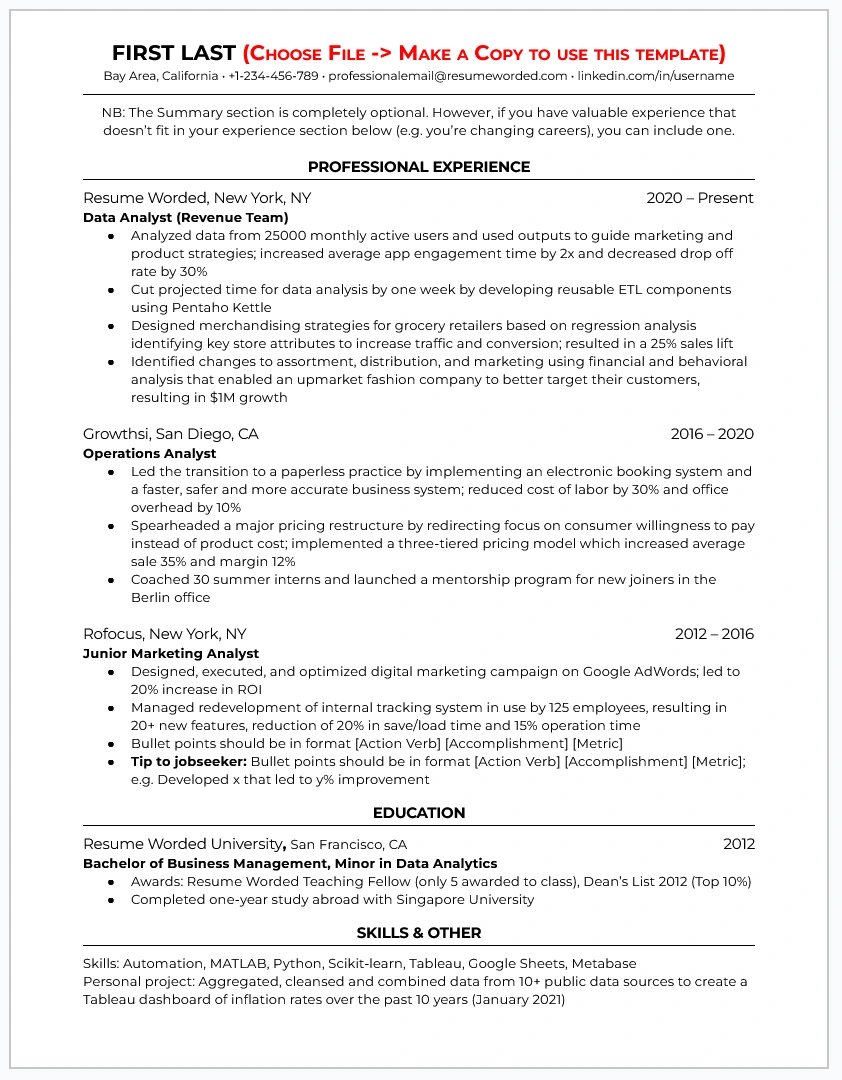
1. Contact Information
2. Education (list first while in school or recently graduated)
3. Relevant Experience (internships, part-time jobs, projects)
4. Skills (technical skills, languages, certifications)
5. Additional sections (leadership, volunteer work, awards)
Why education goes first: Employers hiring students expect to see your degree, major, and GPA prominently. Moving experience above education signals you're trying to hide weak academics.
Once you have 3-5 years of full-time experience, flip the order, put experience before education.
Avoid functional or combination formats as a student. 76% of recruiters are suspicious of non-chronological formats, assuming candidates are hiding employment gaps (even though students don't have traditional work histories).
Section order matters: Our analysis of 85,000 student resumes shows that education-first resumes receive 31% more interview requests for entry-level roles than experience-first layouts.
Last updated: January 2026.
Do these student templates work for internship applications?
Yes, our student templates are specifically designed for internship applications, co-op programs, and entry-level roles.
What makes them internship-ready:
• Education section formatted for current students (expected graduation date)
• Projects section (since internships value potential over experience)
• Skills section prominence (what you can contribute immediately)
• Clean, professional design (shows you understand workplace norms)
• ATS-compatible (most corporate internship programs use applicant tracking systems)
• One-page length (standard for internships)
Internship application statistics:
• 67% of internships require a resume submission
• 82% of companies use ATS for internship screening
• 94% of our student templates pass major ATS systems
• Average internship posting receives 50-100 applications
Templates work for:
• Summer internships
• Co-op programs (semester-long)
• Part-time internships during school
• Post-graduation internships
• Research assistantships
Tested with campus recruiting systems: Handshake (98% parse rate), LinkedIn (97%), company career portals (95%), and major ATS platforms (Workday 96%, Greenhouse 95%, Lever 93%).
Last updated: January 2026.
Check Your Student Resume
Make sure your resume passes ATS systems used by internship programs and entry-level roles.