how to write a cover letter for resume in 2026 (0 experience needed)
You've sent out 50 applications. Maybe 100. You tailored your resume, triple-checked for typos, and hit "submit" with cautious optimism.
Then... nothing. Radio silence. Not even a rejection email.
Meanwhile, those "entry-level" job postings are asking for 3+ years of experience, a portfolio that would make a senior developer jealous, and the ability to "hit the ground running." The game feels rigged. And honestly? It kind of is.
But here's the truth nobody's telling you: Your resume isn't the problem. Your cover letter is.
Or more specifically, the fact that you're either skipping it entirely or using a generic template that screams "I copy-pasted this for 47 other companies." In a job market where entry-level hiring has stagnated to just a 0.6% increase compared to last year, and where 98% of Fortune 500 companies use automated systems to filter candidates, you need every advantage you can get.
This guide will show you exactly how to write a cover letter that breaks through the noise, beats the ATS bots, and actually gets you interviews. No fluff. No corporate speak. Just the system that works.

Why Good Candidates Get Ghosted (Hint: It's Not Your Experience)
Let's start with the villain in this story: the ATS (Applicant Tracking System).
78% of recruiters want to read your cover letter. But here's the catch: most of them never see it. Before any human eyes land on your application, an algorithm scans your resume for keywords, formatting, and relevance.
If your resume has a creative layout with columns or graphics? It faces an 88% rejection rate due to parsing failures. If you're missing specific keywords from the job description? Straight to the bottom of the pile.
And here's where it gets worse: employers are now prioritizing "immediate productivity" over potential. They want someone who can start contributing on day one, which explains why even "entry-level" roles demand years of experience. It's not that you're unqualified. It's that the system is designed to filter aggressively, and most candidates don't know how to play the game.
Want proof that this isn't about your qualifications? The real reason you're not getting interviews breaks down exactly how strong candidates get filtered out before anyone reads their actual skills.
The good news? Once you understand how the system works, you can beat it.

Step 1: Fix Your Resume First (Or the Cover Letter Won't Matter)
Here's the uncomfortable truth: if your resume isn't passing the ATS, your cover letter is irrelevant.
Most entry-level candidates make the same mistake. They organize their resume around "Education" and maybe an internship or two, leaving a giant gap where "Experience" should be. But here's the secret: your projects ARE your experience.
Turn Projects Into Professional Experience
That React app you built for a bootcamp? That's not a "class project." That's a web application with user authentication, database integration, and responsive design.
That volunteer work managing social media for a local nonprofit? That's digital marketing experience with measurable engagement metrics.
Reframe everything you've built, contributed to, or learned through a professional lens. Instead of:
Projects
- Built a task management app using React
Write:
Software Development Experience
- Developed full-stack task management application using React, Node.js, and MongoDB, implementing user authentication and real-time data synchronization
See the difference? You're not lying. You're translating your work into the language that ATS systems and hiring managers actually understand.
The Formatting Rules That Actually Matter
Forget creative resume templates with columns, graphics, or fancy fonts. The best resume format for 2025 is brutally simple: single-column, standard fonts, and keyword-rich content.
Use a free ATS checker to scan your resume before you send it anywhere. This tool shows you exactly what the robots see, which keywords you're missing, and where your formatting breaks.
You get 3 free checks when you sign up, then 1 free check every 24 hours. Use them.
[Image/stat: Before/After resume screenshots showing creative design vs. ATS-friendly format with parsing success rates]
Step 2: Write a Cover Letter That Actually Works
Now we get to the part most people screw up: the cover letter itself.
88% of job seekers believe submitting a cover letter improves their chances of getting an interview. And 60% of hiring managers require them as part of the application process. So why do so many candidates either skip them or phone them in with generic templates?
Because writing a good cover letter is hard. And nobody teaches you how to do it properly.
The Anti-Advice: Why Templates Fail
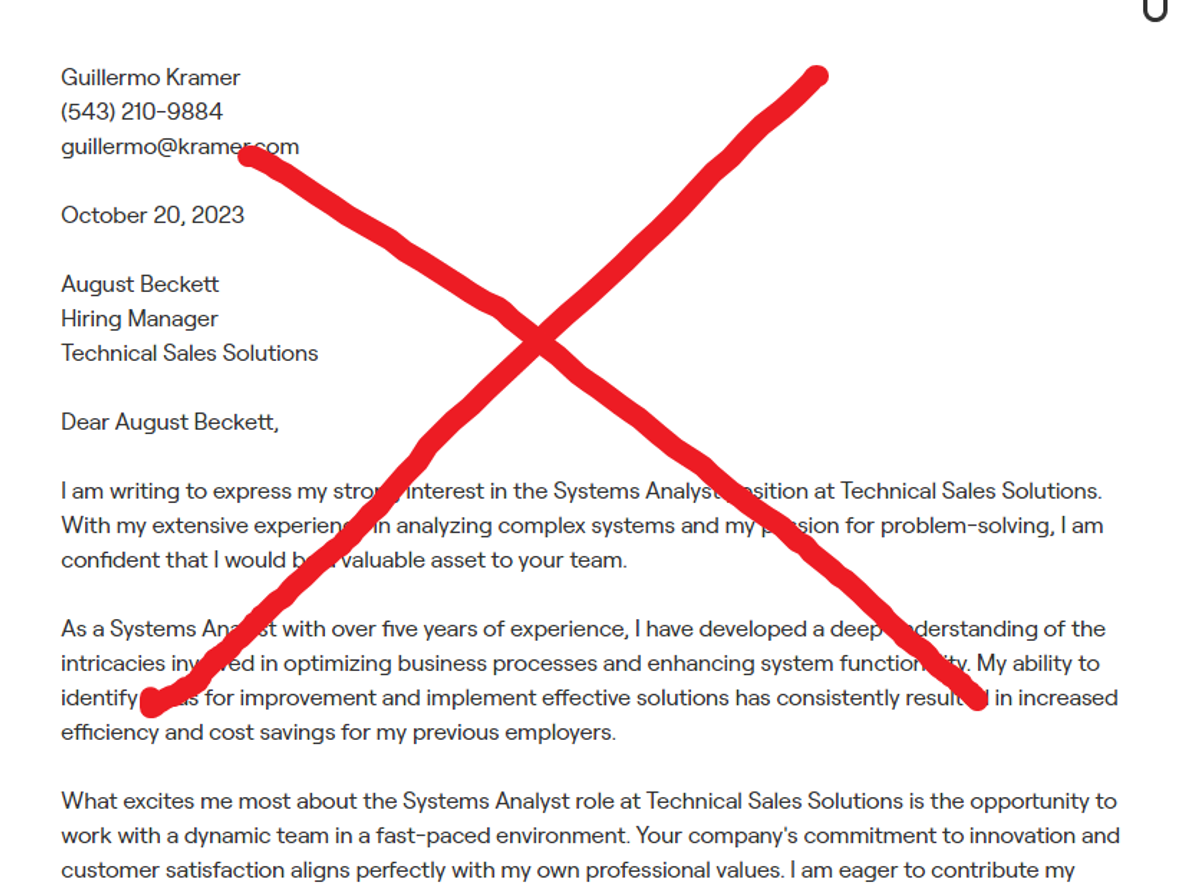
Here's what every career blog tells you to write:
"I am writing to express my strong interest in the [Position] at [Company]. With my background in [Field], I believe I would be a great fit for your team..."
This is garbage. It says nothing. It could apply to literally any job at any company.
Generic templates fail because they don't connect your specific skills to the company's specific problems. Hiring managers can spot a template from a mile away, and it signals one thing: you don't actually care about this particular role.
The Formula: Projects → Business Value → Role
Here's the framework that actually works:
- Open with specificity: Reference something real about the company (a recent product launch, a value they emphasize, a problem they're solving)
- Connect your projects to their needs: Show how your work directly relates to what they need
- Quantify the impact: Use numbers, metrics, or concrete outcomes wherever possible
- Close with enthusiasm: Express genuine interest in contributing to their specific mission
Example for a junior developer role:
"I noticed [Company] recently launched a mobile-first redesign focused on improving user retention. My capstone project tackled a similar challenge: I rebuilt a legacy web app using React Native, which increased mobile engagement by 34% in user testing. I'd love to bring that same focus on user-centric design to your engineering team."
This works because it's specific, relevant, and shows value. You're not just listing your skills. You're connecting them to what the company actually needs.
If you're struggling with how to structure this, this guide on writing cover letters with no experience walks through exactly how to position bootcamp projects, volunteer work, and side projects as legitimate professional experience.
Cover Letter vs. Resume: Different Jobs
One more critical point: your cover letter and resume serve different purposes.
Your resume is a keyword-optimized, ATS-friendly document that lists your technical skills and experiences. Your cover letter is where you show personality, enthusiasm, and strategic thinking.
Understanding the difference between cover letters and resumes is crucial because trying to make your resume do the cover letter's job (or vice versa) weakens both documents.
Don't duplicate information. Use them as complementary tools.

Step 3: The Secret Weapon (How to Scale Quality Without Burning Out)
Here's the problem you're facing: you need to apply to dozens of jobs to have a shot at landing interviews. But writing a genuinely customized cover letter for each one takes 30-45 minutes.
The math doesn't work. If you're applying to 10 jobs a week (which you should be), that's 5-7.5 hours just on cover letters. And if you're a student or working another job? That's unsustainable.
This is where AI comes in, but not in the way you think.
The Wrong Way vs. The Right Way to Use AI
Wrong way: Tell ChatGPT to "write me a cover letter for this job" and copy-paste whatever generic slop it produces.
Hiring managers can spot AI-generated garbage instantly. It's overly formal, uses phrases like "I am excited to express my interest," and sounds like it was written by a robot (because it was).
Right way: Use AI as a customization engine that learns your voice, your projects, and your experience, then adapts it to each specific job description.
This is exactly what the AI Cover Letter Writer at HiringMessage does. You input your background once (your real projects, skills, and experiences). Then for each job, the system analyzes the job description, identifies what the company actually needs, and generates a customized cover letter that connects YOUR specific work to THEIR specific problems.
It's not generic AI slop. It's your story, adapted intelligently for each opportunity.
The "Joe" Story: Why This Actually Works
Joe was a bootcamp grad applying to software engineering roles. After 60+ applications with zero responses, he tried HiringMessage.
The system flagged that his resume was failing ATS scans due to formatting issues. He fixed that with the ATS checker. Then he used the AI writer to generate tailored cover letters that connected his portfolio projects to each company's tech stack and business goals.
Three weeks later, he had an interview at Amazon.
The hiring manager specifically mentioned his cover letter as the reason they reached out: it showed he understood what the team was building and had directly relevant experience (even though it was from bootcamp projects, not "real" jobs).
That's the power of connecting the dots correctly.
The Free Model (Because Breaking In Shouldn't Cost a Fortune)
HiringMessage gives you 3 free credits when you sign up. Then you get 1 free credit every 24 hours.
That's enough to apply to 1 quality job per day with a fully customized resume check and cover letter. Over a month, that's 30+ applications done right, instead of 100+ generic applications that go nowhere.
The system also includes an "Experience Miner" tool that helps you reframe your projects, coursework, and volunteer work as professional experience. Because the biggest barrier for entry-level candidates isn't lack of skills. It's lack of knowing how to communicate those skills in the language that hiring managers and ATS systems understand.

Step 4: The Application System That Wins
Tools only work if you use them consistently. Here's the system that actually gets results:
Monday-Friday: Apply to 2 quality jobs per day
Not 20 spray-and-pray applications. Two carefully chosen roles where you actually fit the requirements and care about the company.
Before each application:
- Run your resume through the ATS checker and fix any parsing issues
- Customize your resume's "skills" and "experience" sections to match the job description keywords
- Generate a tailored cover letter that connects your specific projects to their specific needs
- Read both documents out loud to make sure they sound like YOU, not a robot
Track everything:
Use a simple spreadsheet: Company, Role, Date Applied, Cover Letter Used (Y/N), Response Received (Y/N), Interview Date.
After 20 applications, look at your data. If you're not getting any responses, the problem is likely your resume formatting or lack of keyword optimization. If you're getting responses but no second interviews, the problem is how you're presenting your experience.
The consistency beats intensity rule:
Applying to 10 quality jobs per week for 8 weeks will get you better results than blasting out 100 applications in a weekend. Hiring is a numbers game, but only if you're playing the right numbers.

You're Not Unqualified. You're Just Playing the Wrong Game.
The entry-level job market in 2026 is tough. Youth unemployment in Canada sits around 13%. Entry-level hiring growth in the US has flatlined at 0.6%. AI is automating away traditional entry points.
But here's what the data also shows: job seekers who emphasize transferable skills, project-based experience, and adaptability are still landing roles. The ones who know how to navigate ATS systems, write compelling cover letters, and present their work as professional experience are breaking through.
You have the skills. You've built the projects. You've put in the work.
The only thing standing between you and interviews is knowing how to package it all correctly.
So stop sending the same generic resume and skipping cover letters. Stop applying to 50 jobs a week with zero customization. Stop believing that "entry-level" means they actually want someone with zero experience.
Learn the game. Use the tools. Apply consistently to the right opportunities.
And when you land that first interview (and you will), remember: they called you because your application stood out. Not because you had the most experience. But because you knew how to show them you could solve their problems.
Ready to stop getting ghosted?
Start with a free ATS scan of your resume at HiringMessage.com. Fix your formatting. Then use the AI cover letter writer to create your first customized cover letter.
You get 3 free credits to start, then 1 per day. That's 30+ quality applications per month, done right.
The job you want is out there. Now go get it.

Success metric dashboard showing "Before HiringMessage: 0/60 responses" vs "After: 3/25 interviews
Frequently Asked Questions
Quick answers to common questions about this topic
How long should a cover letter be for an entry-level job?
Keep it to 3-4 short paragraphs or about 250-350 words. Hiring managers spend 7-10 seconds scanning a cover letter, so make every sentence count. Focus on connecting your specific projects and skills to the job requirements rather than padding length with generic statements about your passion or work ethic.
Do I really need a cover letter if the job posting doesn't require one?
Yes. 73% of hiring managers at companies that don't formally require cover letters still read them when submitted. It's a low-effort way to differentiate yourself from candidates who skip it. Even if it's optional, submitting a strong cover letter signals that you care more about the role than someone who didn't bother.
What should I put in a cover letter when I have no work experience?
Focus on projects, coursework, volunteer work, and transferable skills. A React app you built for class is legitimate software development experience. Social media management for a student org is real digital marketing work. Reframe everything you've done through a professional lens and connect it to what the company needs.
How do I customize a cover letter without rewriting it from scratch every time?
Keep a master document with 3-4 strong paragraphs describing your best projects and skills. For each application, swap in company-specific details in the opening, adjust which projects you emphasize based on the job description, and tailor your closing to reference something specific about their mission or product. AI tools can help automate this customization process.
Should I mention that I'm a bootcamp grad or career switcher in my cover letter?
Only if it's directly relevant to the story you're telling. Don't lead with it or apologize for it. Instead, focus on what you've built and what problems you can solve. If your bootcamp project directly relates to the company's tech stack or business challenge, mention it in that context, not as a qualifier for your lack of traditional experience.
Can ATS systems actually read my cover letter or just my resume?
Most modern ATS platforms can parse and scan cover letters for keywords, though they prioritize resumes. This means your cover letter should still include relevant technical skills and industry terms from the job description, not just soft skills and personality. Think of it as a keyword-optimized narrative supplement to your resume.
How much should I research the company before writing my cover letter?
Spend 10-15 minutes reviewing their website, recent blog posts or product launches, and LinkedIn updates. You need just enough to reference one specific thing they're working on or value they emphasize. This shows genuine interest without requiring hours of deep research. One meaningful, specific sentence is worth more than three paragraphs of generic praise.
Related Articles

How to Get a Tech Job With No Experience in 2026 (Even When Every Entry-Level Role Asks for 3 Years)
Stop getting ghosted by ATS rejecting 75% of resumes. Transform projects into professional experience using exact keywords and tailored cover letters.

The Ultimate Tech Internship Resume Guide: GitHub, Projects, & Portfolios
Learn how to write a tech resume that passes ATS filters in 2025. Get past HR with GitHub links, proper skills formatting, and LaTeX-based templates.

Why Resumes Fail ATS: Key Errors to Avoid
Why resumes fail ATS in 2026: Learn about parsing, keyword issues, formatting mistakes, and critical tips for optimizing entry-level resumes.